The Entrepreneurial Edge
What people come to you for, and how far it reaches without you.
Picture a cook who makes the best biryani in town.
She started with four tables and one pot. Every plate that left the kitchen, she made herself. That's why people came back. That's why they told their friends.
She's very good at this. That's the whole point. It's what built the place.
So the queue grew. She added more tables. She hired two people to wash up and one to take orders. She made the recipe even better.
And still, every plate waits for her.
The new tables fill up and the food comes out slower. On the day she's sick, the kitchen closes. Nothing is wrong with the biryani. She's still the only one who can make a plate.
Ask her what makes her biryani different and she'll shrug. It's just how I make it. She's stood at that stove so long she can't see it anymore.
Perhaps you recognise some version of this.
You're good at what you do. That's why you have a business at all.
So you keep making the product better. You keep hiring and adding new tools. And the work still lands back on your desk, waiting for you.
Every entrepreneur has an edge: the thing you do that nobody else does quite the same way. But very few recognize it and capitalize on it. In fact, more are actually blind to it.
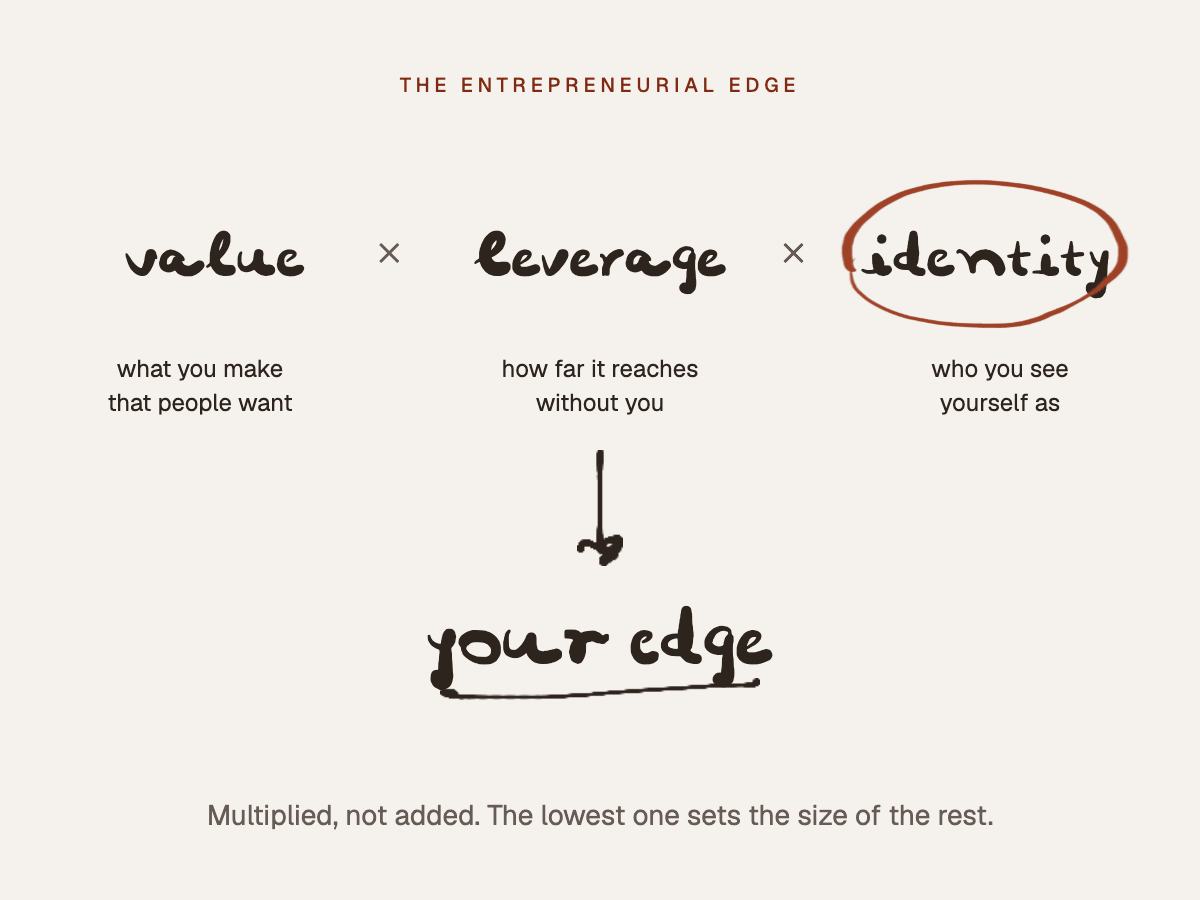
Your Entrepreneurial Edge = Value x Leverage x Identity
I call this the Entrepreneurial Edge. It has three parts, and when multiplied together, they can create an unfair advantage for you and your business.
Value is what you make that people want and come back for. For the cook, it's the biryani. For you, it might be the way you get to the real problem in a client's first ten minutes, or the one detail in your product nobody else bothers with.
Leverage is how far that value reaches without you doing it all yourself. It's the people, systems and tools that carry your value to tables you'll never see.
Identity is who you see yourself as. The one who makes every plate, or the one who builds the kitchen that makes the plates. This is the part that decides whether you'll let the other two grow.
Most founders work hard on the first two. The third one is quieter. Nobody puts it on a to-do list.
Because the parts are multiplied, the lowest one pulls the others down. Say you score 10 on Value, 10 on Leverage and 1 on Identity. Ten times ten times one is 100. Move Identity up to 5 and the same business, with the same product and the same people, gives you 500.
That's why adding more stops helping after a while. If you still see yourself as the one who has to make every plate, the whole result stays small.
The cook builds great plates. For the restaurant to grow, she has to start building the cooks, and the way the kitchen runs, so great plates come out when she's nowhere near the stove.
Your Blind Spot
You can't see your own edge, because you're standing inside it.
Your edge is what people come to you for. It built the business. From the inside, it just looks like the way you work, so it's hard to see clearly.
So when growth slows, you add more effort. More hours at the stove. What your edge needs is room to reach further than you can carry it yourself.
So how do you know where you stand? These are the signs I see most often.
You haven't named your edge yet if:
You can't say in one sentence why your best clients pick you over a cheaper option. You say “quality” or “service”, which is what everyone says.
Your biggest client asks for you by name, and goes quiet when someone from your team picks up the call.
You rewrite every proposal your sales lead drafts, and you couldn't tell her what you changed or why.
You've grown past your edge if:
Your week goes on finance reviews, hiring calls and fixing problems, and the work that built the company gets an hour on Friday evening, if it's lucky.
Your team delivers the work, but customers say it doesn't feel the same since you stepped back.
That's the cook at the stove. Her biryani is fine as it is. It just can't reach more tables than she can carry.
What it costs you, and what it gives you
If you can't name your edge, you can't protect it, price it or teach it. So you compete on what everyone else competes on: lower prices, faster delivery, longer hours. The business only grows as fast as you can work.
When you find it, things get simpler. You know what to say yes to and what to hand over. Your best customers can tell their friends exactly why they come to you. And more of your week goes to the part that grows the business most.
Training your team on your Edge.
Your edge can't stay a feeling in your head. It has to become something other people can see and copy.
For the cook, that means writing down why she toasts the spices for exactly that long. It means tasting every plate beside a new cook and saying out loud why this one works and that one doesn't. Then it means letting that cook send a plate out without checking it first.
Teach the why, not only the steps. Steps get followed. A why gets understood, and your team can use it when something comes up that you never planned for.
Keep your hands on it
There's a trap on the other side too. A baker opens a shop because she loves to bake. Ten years later she runs three shops. It's been years since she baked a cake herself, and somewhere along the way the joy went out of it.
With a hobby, you can do all of it yourself. A business is different. At some point you can't be the one who does everything. Focus on the parts you enjoy most and do best, and find people and systems for the rest. But stay in touch with the part that made you start.
There's a lot of talk right now about handing everything off, to a team or to AI. I don't agree. The work that creates the most value, and gives you joy, is worth keeping your hands on. Bake the cake sometimes. That's how your edge stays sharp.
Do This To Fix Your Blind Spot
Find your edge, then let it reach past you.
You don't have to do it all at once. Start with one plate.
One thing to try this week
Name your edge. Write down the one thing people come to you for that you'd do even if nobody paid you.
Ask how far it reaches. Does the business let it reach past you, or does it still wait for you to do it yourself?
Build one thing that carries it. Pick what someone else would need to do it your way: a skill, a written step, or permission to decide. Teach it, write it down, or hand it over.
Score yourself. Out of 10, how much do you see yourself as the one who builds the kitchen, and not the one at the stove? Write the number down and check it again in a month.